High Street Kensington
Tell the council you want A safe, protected cycle lane on Kensington High Street.
Has the RBKC Council created the first invisible cycle lane?
Kensington High Street has undergone some changes in August 2023 with new partial ‘advisory’ lanes being painted on its western (west of the Design Museum) and eastern (east of Palace Avenue) sections. Despite the Council communicating widely on the implementation of cycle lanes on Kensington High Street (KHS), there is no change to its main section -and busiest stretch- that most of us would actually call Kensington High Street.
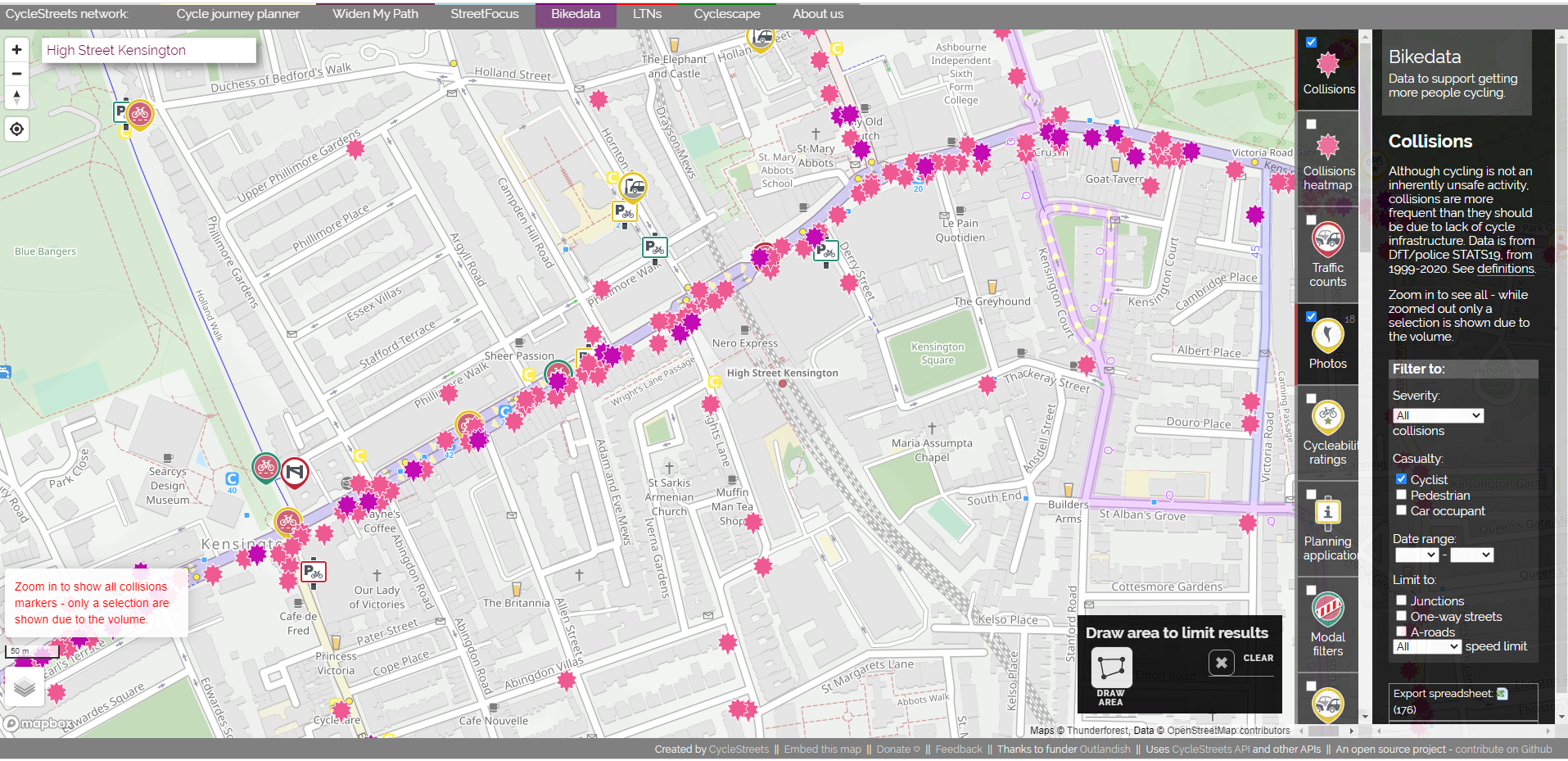
With the volume of serious accidents occurring on KHS and given the feedback from residents at the back RBKC’s own consultations, it is hard to comprehend why nothing of material significance is delivered by RBKC to boost safety on a major cycling route that connects Hammersmith’s Cycleway 9 to Hyde Park cycling routes with 3,000/4,000 cycle journeys per day.
Help us to keep pressure on RBKC Council, urging them to act fast on making the lane continuous on the whole length of the street. This will add much needed protection for cyclists and develop a long-term solution aligned to government and Transport for London safety standards.
Make your voice heard by sending an email to the Leader of the Council and to the Lead Member for Planning and Environment.
The Center for London recommends
protected cycle lanes
In 2022, a long-promised study was commissioned by RBKC Council to provide an independent view of the best road design for High Street Kensington. The ‘traffic patterns study’ was delivered in the form of a report by the Centre for London in the summer of 2022, and published in October 2022.
For 90% of the street’s length, the report recommended protected cycle lanes separated from general traffic (whether “bi-directional”, that is with one bigger lane for bike traffic in both directions, such as on the Embankment between Westminster and the City, or “with-flow”, that is a lane on each side of the road between the pedestrian pavement and lanes for motor traffic. There are many examples of each, in line with the Department for Transport’s (DfT’s) design standards).
For the remaining 10% of High Street Kensington – the “pinch point” just East of Kensington Church Street – the report recommended either protected bike lanes or other measures such as a “bus gate” that would eliminate most motor traffic and mean that protected lanes would not be needed on this stretch. This is because government guidance is very clear that with high motor traffic volumes like on High St Ken there must be protected bike lanes, so the only alternative is to reduce motor traffic through measures such as only allowing buses through.
Rather than act on the conclusions of the report (most obviously by starting a normal consultation process for the design of the lanes), RBKC tried to delay matters further.
The report had been put together with a large group of local resident groups and stakeholders.
High Street Kensington - Cycle collision map
Most recent public consultations actually
supporT physically segregated
cycle infrastructure
Delving into the results from RBKC’s May 2023 consultation on these advisory cycle lanes, the data reveals some compelling findings:
From 1,605 respondents, 61% voiced their preference for protected cycle lanes (often referred to as ‘seg’) when asked by RBKC Council about proposed ‘advisory’ lanes. This high turnout in itself testifies to the impassioned opinions of both RBKC residents and visitors.
One cannot ignore the predominant ‘key themes’ emerging from this consultation. Out of all feedback, 1,015 responses emphasised the necessity of protected lanes when, in contrast, the next prevalent opinion tallied at just 414, where respondents expressed no desire for cycle lanes whatsoever. That’s 2.5 times the emphasis on the need for protection!
Total Respondents: 1,605 individuals shared their views on the new lanes.
Majority’s Choice: 61% (approx. 1,000 people) favor protected cycle lanes.
Safety Emphasis: 1,015 responses underscored the need for protected lanes, overshadowing the 414 against any cycle lanes by 2.5 times.
What has the Council’s response be?
The council, in response, cites a trial of a protected cycle lane scheme on Kensington High Street from Autumn 2020.
This scheme was short-lived as we know, facing removal after some objections from local residents (we won’t dive back here into the history and details of the Judicial Review).
Fast forward to early 2023, and the Council’s Citizens’ Panel survey indicates a more favourable view towards painted cycle lanes rather than segregated ones. The statistics from this survey highlight a 43% support for painted lanes with a 33% opposition.
Time for change - Make your voice heard!!!
The data and public opinion speak volumes. With safety as a primary focus, the partial painted lanes seem to be more of a cosmetic addition than a protective measure. Given the history of serious cycling injuries on this stretch, the need for continuous, protected lanes throughout Kensington High Street is undeniable as a short-term remediation step, until a more structurally rethink of the area is done.
We, along with numerous residents and visitors, urge the council to swiftly implement continuous segregated lanes along the street’s entire length, incorporating protective measures. Additionally, integrating cycle signals at junctions will ensure a safer, more efficient experience for all road users.
The council now stands at a crossroads. The decision ahead will either cement Kensington High Street’s legacy as a safety-first, cyclist-friendly avenue or relegate it to yet another missed opportunity in London’s urban planning annals. Only time will tell.
Painted cycle lanes aren’t safe on High Street Kensington. Here’s why
Advisory cycle lanes are completely inadequate on these busy A-roads.National government standards say that protected lanes are needed where traffic volumes are high. Kensington High Street has 21,000 vehicles per day. While cycle tracks protected with kerbs or wands greatly reduce risk, studies show that advisory lanes can actually increase the risk of collisions compared to no cycle infrastructure at all. But with thousands of people cycling on each of these roads every day – over 3,000 on Kensington High Street– the safest possible solution is needed urgently.
Proper cycle infrastructure will prevent many further injuries and deaths.
At junctions, the council proposals show only advanced stop lines (ASLs or bike boxes) at traffic lights. This is better than nothing, but ASLs only help you if you reach them on a red light (and are not filled up with a vehicle!). The risk remains of drivers turning into you while you try to ride straight ahead. On these busy roads, junctions need to be much safer for cycling. There are lots of solutions, like cycle traffic signals that let bikes have their own cycle, or give bikes a few seconds before general traffic (advance signals), or keep cycles on red while motor traffic turns left. But the plans on the table offer none of those.
Tell the council they must do better
The council have declared a climate emergency. They say they want greener streets where more people choose to walk and cycle. Tell them that these proposals will *not* achieve that. They will not get more people out of cars and taxis and they will not keep those safe who are already cycling. They must do better, now.
THE BACKGROUND STORY TO HIGH STREET KENSINGTON CYCLE LANES
Lives still at risk on High Street Kensington since removing the cycle lanes in December 2020
While thousands of people continue to risk their lives daily travelling by bike on High Street Kensington, there’s been no change since the protected cycle lanes were removed in December 2020.
High Street Kensington is used by thousands of people travelling by bike every day. It’s part of a key route for Londoners, both residents of Kensington & Chelsea as well as people coming here to visit, study, shop and work. Ten years after they were promised by The Royal Borough of Kensington & Chelsea Council (RBKC), finally in Autumn 2020 protected bike lanes were installed – but then removed just seven weeks later. In that time the lanes were hugely successful, with cycle numbers more than doubling to 3-4,000 journeys a day. Kids and key workers were able to ride safely to school and work, many for the first time.
Judicial review of High Street Kensington decision
As Better Streets for Kensington & Chelsea, we challenged their removal as unlawful in a judicial review process. After over two years of legal work, the case was heard in the High Court and we were not successful. This was obviously disappointing, especially given the case was lost over points of public administrative law, not the fact that safe cycle infrastructure is urgently needed on this dangerous road. Here is our statement about the judicial review. In our eyes it was a hollow victory for Kensington & Chelsea Council, but more importantly it doesn’t change the urgent need for a safe cycle route now after the protected cycle lanes were removed in December 2020.
Read more about the case and its background here.
Centre for London recommends protected cycle lanes
Meanwhile, a long-promised study was commissioned by RBKC Council to provide an independent view of the best road design for High Street Kensington. The ‘traffic patterns study’ was delivered in the form of a report by the Centre for London in the summer of 2022, and published in October. For 90% of the street’s length, the report recommended protected cycle lanes separated from general traffic (whether “bi-directional”, that is with one bigger lane for bike traffic in both directions, such as on the Embankment between Westminster and the City, or “with-flow”, that is a lane on each side of the road between the pedestrian pavement and lanes for motor traffic. There are many examples of each, in line with the Department for Travel’s (DfT’s) design standards).
For the remaining 10% of High Street Ken – the “pinch point” just East of Kensington Church Street – the report recommended either protected bike lanes or other measures such as a “bus gate” that would eliminate most motor traffic and mean that protected lanes would not be needed on this stretch. This is because government guidance is very clear that with high motor traffic volumes like on High St Ken there must be protected bike lanes, so the only alternative is to reduce motor traffic through measures such as only allowing buses through.
Rather than act on the conclusions of the report (most obviously by starting a normal consultation process for the design of the lanes), RBKC tried to delay matters further.
The report had been put together with a large group of local resident groups and stakeholders. RBKC still opted to present the findings to a “Citizens Panel”. In practice this meant a misleading email questionnaire was sent out, with just 321 responses. Far more local people were in fact represented in the Centre for London study process itself.
Also in an attempt to delay any action, the panel views were then presented to the Environment Select Committee – which does actually decide what happens to the roads. All in all, another 9 months were spent getting the views of less people than they already had, and presenting it to a committee that they know isn’t the one with powers to act on the matter.
The Citizens Panel survey
While RBKC council claimed to be consulting residents (via their Citizens Panel) on the Centre for London proposals, they added alternative options that were not recommended – painted cycle lanes and bus lanes. The Citizens Panel respondents were also not representative of RBKC residents and High Street Kensington street users. For example, only 3 respondents were aged under 24 and no one was under 18; over half the respondents were over 60; 84% were white; most had access to a car (while most residents in RBKC don’t).
The report on the Citizen’s Panel response concluded that painted cycle lanes and bus lanes were popular while protected cycle lanes were not. This was not an accurate summary of the responses in our opinion. And Centre for London’s Strategic Development Director, Rob Whitehead said, “The panel survey results look mis-used in an attempt to show that painted line bike lanes are favoured. Yet some of [RKBC council’s] own numbers don’t support this. On safety the combined score of the protected options are favoured by 42% of respondents vs only 14% for painted lanes.”
Our statement at the Environment Select Committee
In April 2023, the council’s Environment Select Committee met to discuss the outcome of the Citizen’s Panel survey. Better Streets for Kensington & Chelsea, London Cycling Campaign and Centre for London were all present to make statements at the meeting. BS4KC member Rachel – an NHS worker who has to face High Street Kensington on her way to work by bike every day – read out a statement for the group. Read it here.
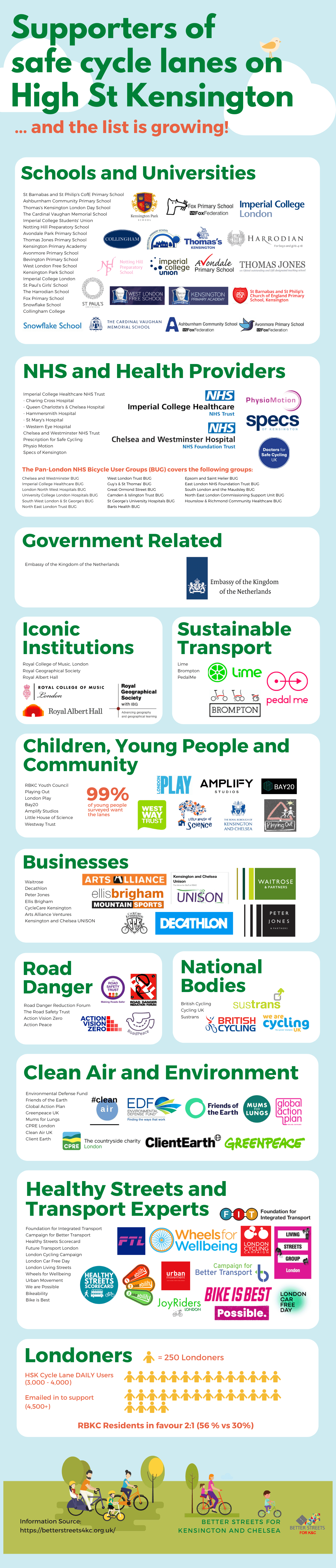
Our main point was that there is a serious lack of urgency to make High Street Kensington safe, nearly 2 and a half years after the protected cycle lanes were removed. Yet support from residents is there, as shown even in the unrepresentative sample gathered by the Citizens Panel. Twenty local schools, the Youth Council, the Chelsea and Westminster Hospital, other NHS trusts, the Royal Albert Hall, Imperial College London and business like Waitrose are all supportive of protected cycle lanes being introduced. Now we need action.
Committee chair (Cllr Tom Bennett) echoed the need for urgency after hearing our statement. Lead Member for Planning & Place (Cllr Cem Kemahli) agreed that ‘safety is paramount’. He said he was ‘heartened’ by the support shown for cycle lanes in the Citizens Panel report and that there are plans being worked on.
Latest Updates on this Campaign